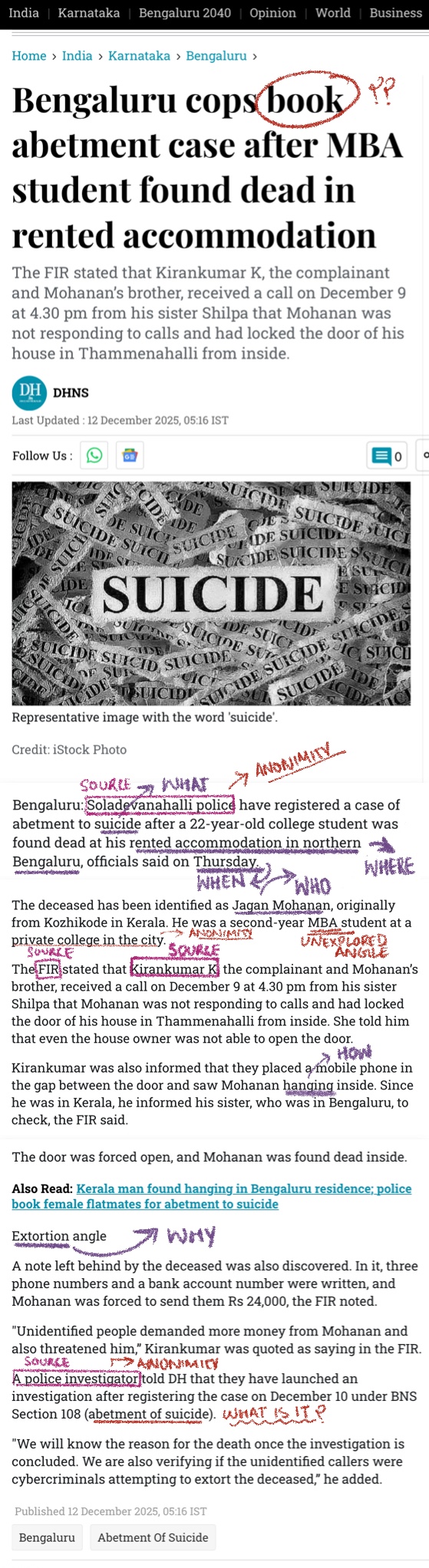
“Bengaluru cops book abetment after MBA student found dead in rented
accommodation” is an article published by Deccan Herald, reporting
the death of a 22-year-old MBA student in Bengaluru.
The report establishes the essential details efficiently. Jagan
Mohan, originally from Kozhikode, was found dead inside his rented
accommodation in Thammenahalli. Jagan was not responding to phone
calls and had locked his home. A phone was placed through the gap in
the door, which revealed him to be hanging inside. The door was
forced open, and he was found dead. His brother filed a complaint,
and an FIR was registered under Section 108 of the Bharatiya Nyaya
Sanhita (abetment of suicide). The timeline and sequence are clearly
presented, and the 5W1H (Who, What, When, Where, Why, How) are
answered concisely.
Information is sourced from Soladevanahali police and a “police
investigator.” Although official sources are provided, they maintain
anonymity, which can weaken the reliability of the information.
The article is anchored on the premise of the FIR (First Information
Report). An FIR is a written document prepared by the police when
they receive information about the commission of a cognizable
offence. It contains the complainant's name and address; date, time,
and location of the incident; the facts of the incident as they
occurred; names and descriptions of the persons involved in the
incident and witnesses, if any.
The article performs well in the domains of accuracy and brevity by
avoiding speculation and sensational language. It is concise and
direct. However, the quality of clarity is compromised as the
article does not state what constitutes abetment from a legal
standpoint. Abetment is the legal act of instigating, conspiring
with, or intentionally aiding someone to commit a crime or
transgression. Cases of abetment to suicide involve the direct or
indirect instigation, conspiracy, or intentional aiding of a person
to take their own life. For this to be applicable, there must be
active participation in the form of inciting, encouraging, or
assisting the victim to commit suicide. According to Section 108 of
the Bharatiya Nyaya Sanhita (BNS), this is punishable by a maximum
of 10 years’ imprisonment and a fine.
The exclusion of this detail weakens the clarity for readers who may
not be aware of the complexity of the charge.
UNEXPLORED ANGLES:
Social & Psychological: The deceased was an MBA student residing in
a rented house. Such a demographic is becoming increasingly common
in the urban settings of Bengaluru. Issues such as migration stress,
academic pressures, online exploitation, and rising mental health
and financial concerns amongst students could have been explored.
The role of institutions in providing awareness about digital safety
could have also been questioned. The case could have also been
investigated further in the context of NCRB trends related to
abetment or student suicides.
Legal: The report could have also examined the difficulties in
establishing the offence of abetment to suicide. Courts require
proof that the accused not only committed acts that distressed the
victim but also intended to facilitate the act of suicide or that
the accused’s acts led to an unbearable situation.
Human-Interest: There are no eyewitnesses or quotes. Without
invading privacy, the report could have included a segment on the
family or the academic institution’s response.
In conclusion, the report meets the minimum standards of crime
reporting: it is factual, objective, and brief. However, it ends
there. By strictly adhering to the FIR and avoiding broader
contextual inquiry, the report informs without critically examining
the case.
Analysing a News Report: Bengaluru Abetment of Suicide Case
FEBRUARY 10, 2026
Prompt: Crime Beat Report